Contents
Do I really need assigned seating?
Seating charts, escort cards, table number cards and place cards
Do I really need assigned seating?
Shouldn't guests choose where they sit? After all we are all adults! In fact a YouGov survey conducted in February 2006 shows that an overwhelming 84% of wedding guests prefer assigned seating.
| preferred being assigned to a specific seat | 51% |
| preferred being assigned to a table (can choose any seat) | 33% |
| free for all - no seats or tables assigned | 13% |
| does not apply, do not/would not attend a wedding reception | 3% |
The results were particularly clear for guests aged over 50, only 8% of whom preferred unassigned seating.
Unassigned seating sounds great in theory and it is certainly one less chore for the organizer. Unfortunately it rarely works out so well in practice.
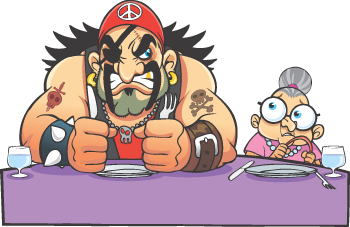
- There may be an unseemly rush for the good' seats.
- It will take a lot longer to get guests seated. They may still be milling around while the food is being served.
- Your beautiful decor will be spoilt by people leaving their coats on chairs to reserve them.
- The last few guests end up walking around looking for seats, a bit like the unpopular kid at school lunch.
- Couples can get split up. It is not unknown for guests to end up eating outside the venue because they couldn't get a seat together at a table.
- Elderly relatives may end up seated where they can't see or hear anything.
- If people turn up uninvited (common in some cultures) they may take seats intended for your invited guests.
It can also be a pretty miserable experience for guests:
"I hate going to a wedding where you have to find a table where all your friends and you can sit... or god forbid you are the people who know the couple but no one else... that is so horrible... even if you are assigned a table you still have to find a place to sit at it... yuck. That is just my opinion... can you tell I have been in this spot a time or two. I have a lot of friends that I have known since I was in grade school, but we went to different schools always, and never had the same group of friends... at their weddings there I was all alone, and no assigned seats, you feel like you are standing there and everyone is staring at you as you try to find what looks like a table of amiable people, and you end up sitting at the table with great aunt lucy because that is all that is left, and she tells you crazy stories that you never wanted to know... yikes... assigned seating is totally the way to go! Just from experience."
Kim on the brides.com discussion board
The larger the event, the bigger the risk you are taking with unassigned seating. In truth, organizers shy away from assigned seating mostly because of the time involved in assigning seats or tables. But it doesn't have to be a huge chore if you use appropriate seating assignment software.
If you still decide to go for unassigned seating then you don't need to read any further on this site. Just make sure you have more chairs than guests and good luck!
Assigning seats or tables?
Guests can be assigned to a table (where they can choose any seat) or assigned to a specific seat. We don't have exact figures, but it seems that assigning tables is probably more common in the USA and assigning seats is more common in Europe. Both approaches are valid and whichever you choose is a matter of personal preference.
Seat assignment
- you can ensure that speakers and VIP guests are seated in the most appropriate seats
- makes it easier for waiting staff to deliver meals to specific guests
- more popular with guests according to a survey
- is a good opportunity for the organizer to do some matchmaking!
Table assignment
- is slightly less work for the organizer
- does not require place cards
- guests have some choice who they sit next to
Seating arrangements
You might want to put people next to people they know, or you might want to split them up a bit so they meet new people. But try to put each person next to at least one person they already know. People are more likely to get on well if they are similar ages or have similar interests. It might not be a good idea to put your 'alternative lifestyle' friend with the piercings and tattoos next to your 80-year-old grandmother. A little common sense goes a long way.
Generally you should try to put families together and work colleagues together. But if you know people don't get on, try seating them separately. It is worth breaking with tradition to have a stress free event.
Avoid mixing age groups too much. Young children should be seated with their parents. Older children can be seated with their parents, or on a table together.
Try to create balanced tables, with even numbers of males and females. It is traditional to alternate male-female-male-female guests in some cultures. Some business dinners are seated male-male-female-female for variety.
If it is a group of people that know each other well you could try splitting up married couples for extra variety.
Try to avoid putting guests on the same table as ex-partners, unless you are sure this is OK. Remember that every room has 4 corners!
Resist the temptation to have a 'leftovers' table of all the people who didn't fit on other tables. It is probably better to distribute such guests evenly.
Table size, shape and layout
You might want all the tables to be the same size and shape or you might want to vary them. Find out what sizes and shapes are available at your venue.
The figures below give you a rough idea of the venue size required, depending on the number of guests and the type of seating. Note that it doesn't allow for dance floors and other unused space.
| seating type | ideal space per guest | minimum space per guest | ||
| ft^2 | m^2 | ft^2 | m^2 | |
| all standing | 7 | 0.7 | 5 | 0.5 |
| all seated, rectangular tables | 11 | 1 | 8 | 0.7 |
| all seated, circular tables | 14 | 1.3 | 11 | 1 |
| all seated, church seating (in rows, no tables) | 8 | 0.7 | 6 | 0.6 |
Recommended space per guest
Example: a room that is 10m x 10m = 100 sq m will hold a maximum of approximately: 200 standing guests, 140 guests at rectangular tables, 100 guests at circular tables and 176 guests seated in rows.
The image below gives you a rough guide for minimum table spacing.
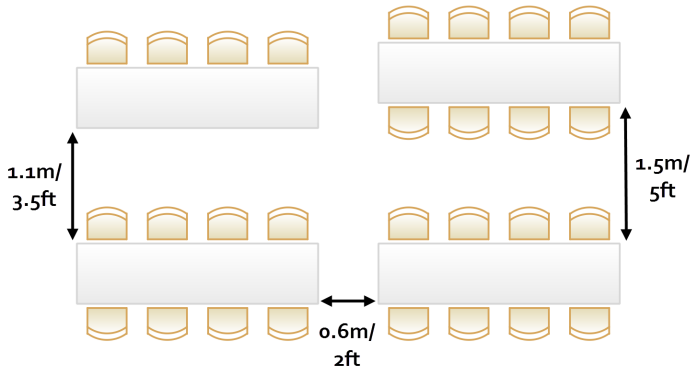
Recommended minimum table spacing
Staggering circular tables allows you to put the rows a bit closer in one direction, but leaves half table gaps at the end of each row. This means that a staggered layout generally works better in large rooms. In an infinite size room a staggered (hexagonal) layout is theoreticaly ~15% more space efficient than an aligned (square) layout, but infinite sized rooms are hard to come by! In reality which is better depends on the exact size and shape of the room.
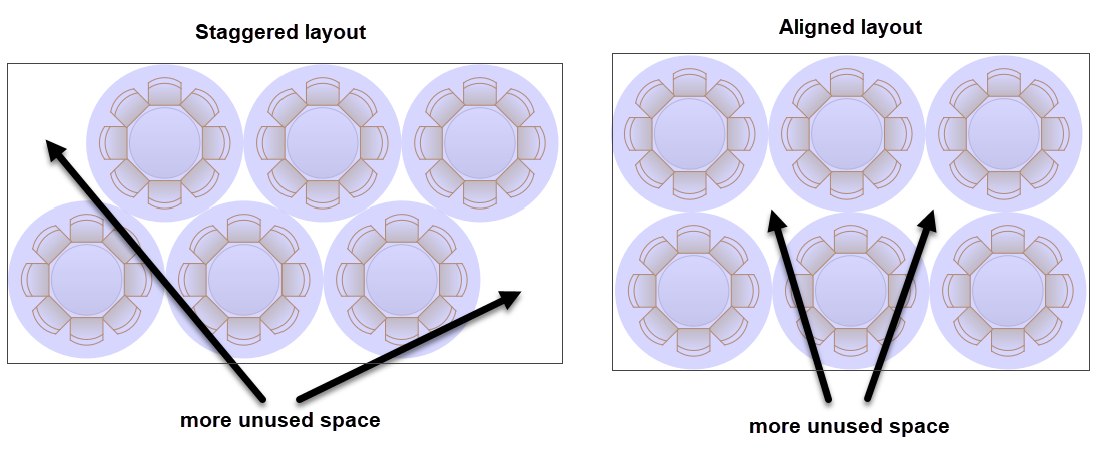
Staggered vs aligned table layout
Note also that an aligned layout is easier to move around for both guests and serving staff.
Using the spacing guidelines, here are the maximum number of guests we can seat in a 15m (45ft) square room. The densest layout has 32% more seats than the least dense. Note how a staggered layout works better for tables of 8 and an aligned layout works better for tables of 10, for this particular room size.
| Table layout | Maximum seated | Example |
| Circular tables of 8, aligned | 200 | 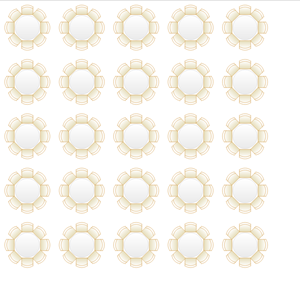 |
| Circular tables of 8, staggered | 240 | 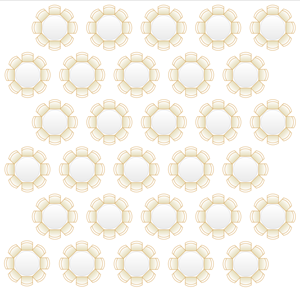 |
| Circular tables of 10, aligned | 250 |  |
| Circular tables of 10, staggered | 220 | 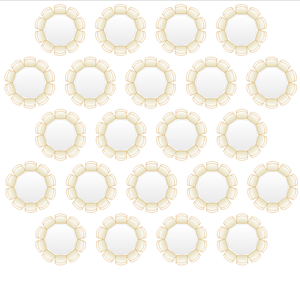 |
| Long tables | 192 | 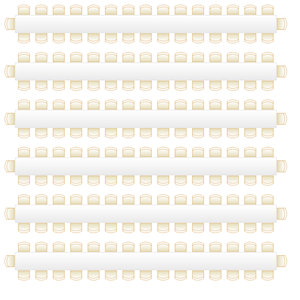 |
| E-shaped table | 189 | 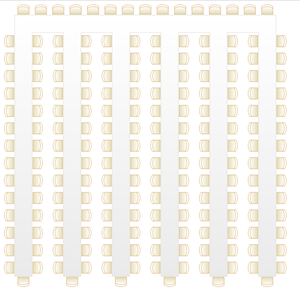 |
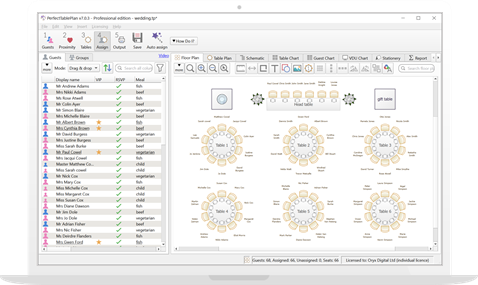
You can easily experiment with table shape, size and layout using PerfectTablePlan's floor plan. If the room is not rectangular or you have obstacles, such as pillars, then you may need to layout your tables using a scale image of the venue.
Make sure the tables are placed so that serving staff have easy access. Don't place a table blocking a door, especially a fire escape. If you have a large venue for the number of guests you may want to put all the tables in one corner to avoid the venue feeling empty.
A good number of seats for a circular table is 8 to 10. If you have more than 10, not all the guests on a table will be able to see/speak to each other. If you have less than 8, you may have problems fitting all the tables into the venue. The figures below give you a rough idea of the number of guests you can fit on a circular table:
| circular table diameter | seats | |
| ideal | maximum | |
| 4 ft / 1.22 m | 7 | 8 |
| 5 ft/ 1.52 m | 8 | 10 |
| 6 ft / 1.83 m | 10 | 12 |
| 7 ft / 2.13 m | 12 | 14 |
| 8 ft / 2.4 m | 13 | 16 |
Recommended circular table seating capacities
(based on 1.9 ft and 1.6 ft circumference per guest for ideal and maximum respectively, guests in wheelchairs may need additional space)
RSVP etiquette
Definition of RSVP: An abbreviation of "répondez s'il vous plaît", which is French for "please reply".
Before you can arrange your seating plan you need to know how many guests are coming. You can confirm numbers by sending out RSVPs. Typically RSVPs are sent out at least a month before the event. Your RSVP should make clear:
- the nature and location, date and time of the event
- who is invited (are children invited?)
- a deadline for accepting (expecting people to reply within a week is not unreasonable)
- how they can accept or decline (e.g. telephone, letter or email)
- (optional) choice of meal
RSVP cards often include a space for the guest to fill-in and return.
You should always include a date by which people must reply, otherwise some people may decide to leave it to the day before the event. Chase up stragglers with a phone call once the reply deadline has expired.
If it is an important event and you want to warn people to keep the date free long before you send out RSVPs, you can send 'save the date' cards.
Assigning seats
If you are having speeches or announcements, try to place the people giving them are seated where they won't have their back to anyone.
Try to place pregnant, elderly and disabled guests and guests with small children where they have easy access to toilets and other facilities. Don't seat them at tables that are going to be removed to make space after the meal.
Older guests will generally have poorer hearing and eyesight. Do try to put them where they can see and hear any speeches. Do not put them next to loud music, they won't appreciate it. Put children's tables in the least favourable locations, they have better hearing and won't be too interested in the speeches anyway.
Seating charts, escort cards, table numbers and place cards
Guests will need to know which table they are seated at so they don't have to walk around every table to find their place. This is usually achieved by displaying a seating chart or escort cards prominently at the entrance to the venue.
Table number cards are placed on tables to display the number or name of the table. If you have a large number of tables you might also want to display a floor plan to show where the tables are.
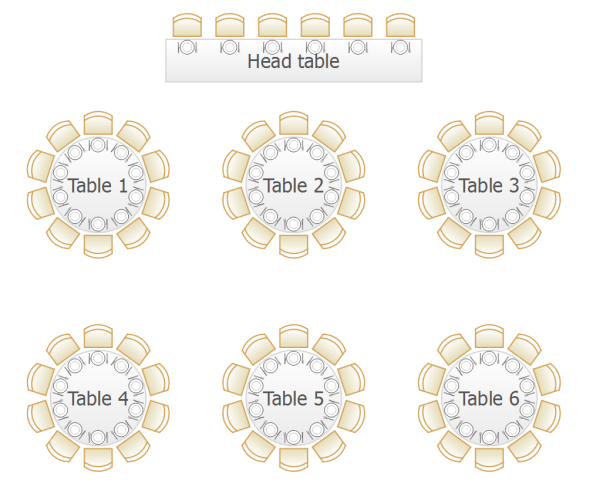
Floor plan (created by PerfectTablePlan)
Place cards are placed at each setting to ensure guests sit in the correct seats.
If you have assigned guests to seats you will need:
- seating chart + table cards + place cards; or
- escort cards + table cards + place cards
If you have assigned guests to tables you will need:
- seating chart + table cards; or
- escort cards + table cards
These can be as simple or elaborate as you like. More important is that you have a good table plan that seats the right people together.
Seating chart
A seating chart shows each guest which table they are seated at. Whether you prefer a seating chart or escort cards is a matter of personal preference. Seating charts are easier to display. They can also be signed by your guests and framed to make a nice memento of the occasion.
The seating chart can either list guests by table or alphabetically by name. Listing by table is more common in the UK and shows who else is on the same table. Listing by guest name is more common in the USA and makes it a little easier to find your table, especially at a large event.
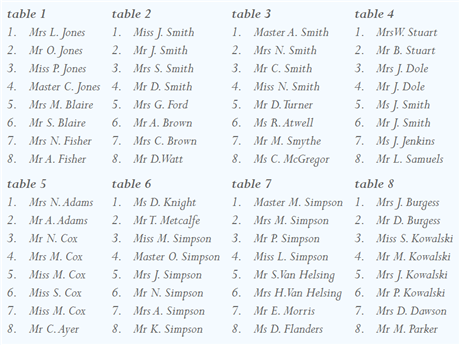
A seating chart listing guests by table (created by PerfectTablePlan)
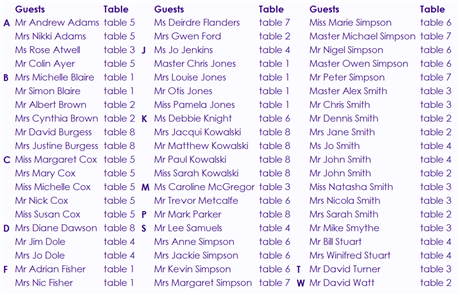
A seating chart listing guests by name (created by PerfectTablePlan)
Whether to display a plain and simple seating chart or a highly decorative/artistic one is very much a matter of personal preference. If you choose an artistic font for your seating chart (e.g. script or gothic), make sure it is readable by all your guests.
Many hotels will have an easel you can use to display your seating chart.
Escort cards
Escort cards show the name/number of the table a guest is seated at. An escort card is usually inside a small envelope with the guest's name written on the outside. You can also use a blank business card and write the name on one side and the table number on the other. Escort cards are very common in the USA. Whether you prefer a seating chart or escort cards is a matter of personal preference. Escort cards have the advantage that they can be changed up to the last minute, whereas a seating chart may need to be printed days or weeks in advance.
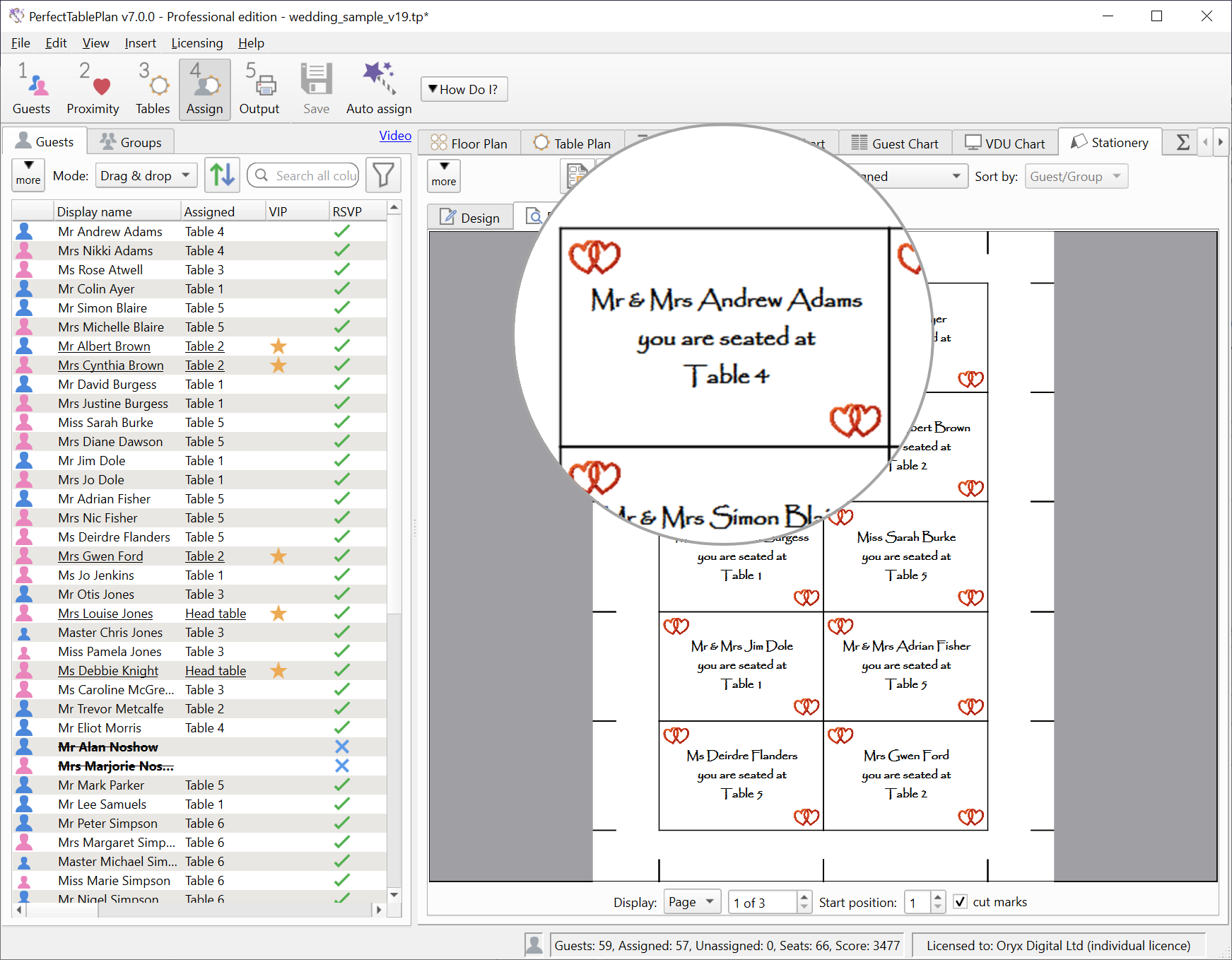
PerfectTablePlan can print escort cards straight from your guest list
Escort cards can be as artistic or as plain as you like. If you choose a calligraphy font for your seating chart or cards (e.g. script or gothic), make sure it is readable by all your guests.
Escort cards are normally placed on a table, in alphabetical order, at the entrance to the venue.
Table number cards
Table number cards are placed on tables to display the table name or number. They should be large enough to read without having to walk right up to the table.
Table number cards are usually large tent fold cards, or flat cards in a holder. Make sure they aren't so tall that they prevent guests seeing each other over the table.
If you have decided to name your tables you can theme the table number cards appropriately.
You can use 'hearts' playing cards for inexpensive table number markers, i.e. Ace of hearts for table 1, two of hearts for table 2 etc.
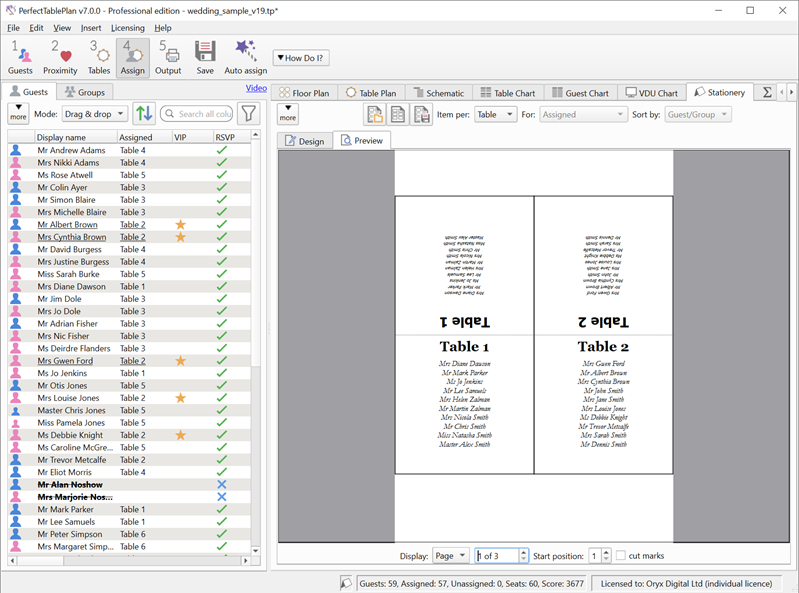
PerfectTablePlan can print table number cards straight from your guest list
Place cards
Place cards are placed at each place setting to ensure guests sit in the correct seats. They are only required if you have assigned guests to seats (not tables). If you are using tent-fold cards, write the guest's name on both sides so that other guests on the table can also read it.
Usually place card names will be in the format "Mr John Smith", but you can use "John Smith" or "Mr J. Smith" depending on the level of formality you feel happy with. Using just the first name is obviously not recommended if there is more than one person with the same first name. Guest names can also be written on personalised favours or menus instead of using place cards.
Place cards can be bought from wedding suppliers and some stationery suppliers. You can either write them by hand yourself, employ a calligrapher to do it for you or print them on the computer. If you are printing them on the computer we recommend you buy sheets of press out place cards, for example ones available from Avery, DecaDry or Sigel.
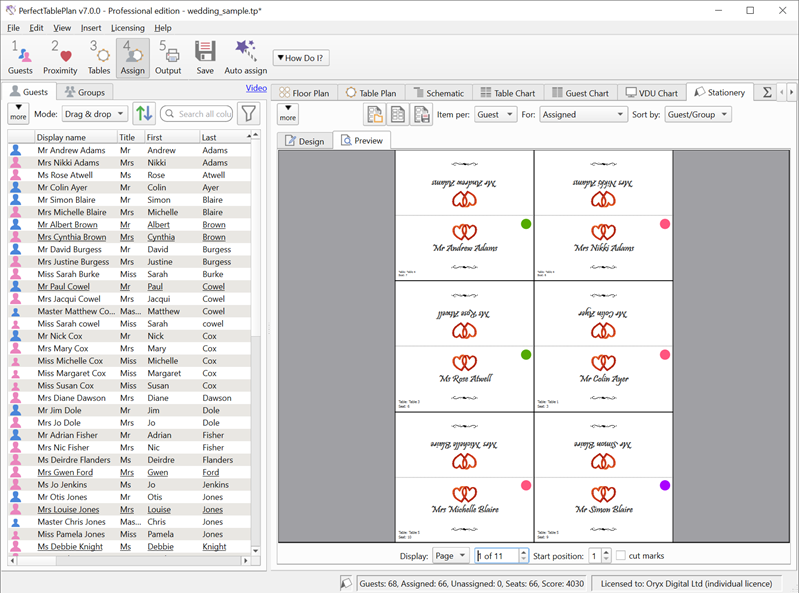
PerfectTablePlan can print place cards straight from your guest list
If you use an artistic or calligraphy font for your place cards (e.g. script or gothic), make sure it is readable by all your guests.
Place cards can be a useful way to communicate to the catering staff which meals people have ordered. E.g. add a red ribbon or dot to the place card for beef and a blue ribbon or dot for fish.
Table names
If you are feeling creative you can give tables names instead of numbers. This is very common for weddings. Numbered tables are less work and easier to find if they are laid out logically. Named tables add a bit more atmosphere and are useful if you are worried about guests being offended about not being seated on "table 1".
Possible table naming themes include:
- flowers (e.g. roses)
- gemstones
- countries/towns
- colours
- actors/films/TV programs
- bands/songs
- cocktails/whiskies/wines
- sweets (=candies)
- animals/birds/butterflies
- sports teams
- dances
- Disney characters
- a word or phrase in different languages (such as 'I love you')
- famous romantic couples
- something appropriate to the number of tables, e.g. the names of the 7 seas or 7 dwarves for 7 tables
- cars/motorbikes
- something related to your hobbies/interests
You can also liven up numbers, for example include a picture of the hosts at age 1 on table 1, at age 2 on table 2 etc.
How to number tables
If you decide to number tables (instead of using table names) then any logical number scheme should be fine. However numbering left to right, top to bottom will probably work best for most westerners.
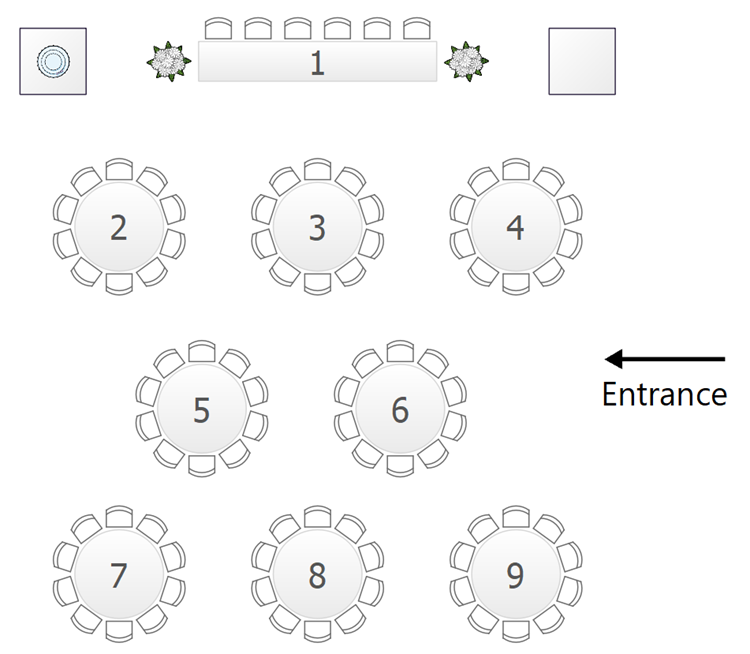
How to number tables (created by PerfectTablePlan)
Elaborate table numbering layouts are likely to cause confusion and are probably best avoided.
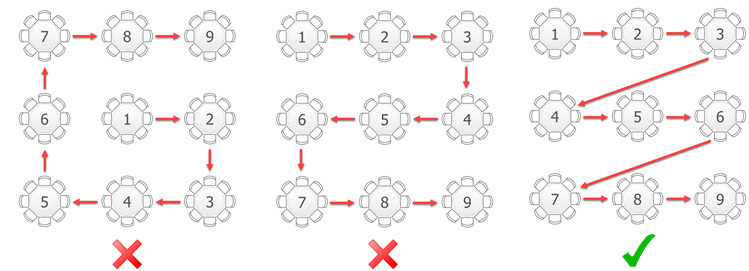
Table numbering layouts
Typically the head/top table is numbered 1, but it doesn't have to be. In fact, giving the head table a number other than 1 might help to allay any feelings about higher numbered tables being less important.
Whatever numbering scheme you go for, it helps to have a floor plan diagram at the entrance to the venue and large, easily visible table number cards, so everyone can quickly find the right table.
Note that some numbers are considered to be unlucky, so you might want to omit them if you think your audience is superstitious.
'Unlucky' numbers include:
- 4 (China)
- 9 (Japan)
- 13 (many Christian countries)
- 17 (Italy)
For example you can replace '13' with '12b'.
Table decorations
Besides cutlery, crockery and glasses, items on the table can include:
- a table centerpiece (usually one or more of: flowers, candles or balloons)
- table glitter
- favors
- a table number card (often in a card holder)
- place cards
- menus
- disposable cameras
It is a good idea to lay it all out on an appropriate size table, before the big day, to make sure it doesn't look cluttered. You may be able to combine table cards, menus and/or favors into one item to save space and money.
Make sure any flowers, table cards or other displays on the table aren't so large that they prevent guests seeing each other.
If you are putting people who don't know each other together, it may be a good idea to provide them with a quiz or some other form of 'ice breaker'.
Give each child a 'goody bag' to keep them amused. This can contains balloons, pencils and paper, small toy etc. It doesn't have to be expensive. Don't give them anything that can cause stains or permanent marks! Bubble blowing kits can be fun but you may end up with soapy tasting food and a slippery dance floor.
Disposable cameras can be a cheap and fun way to record an event. But make sure you leave clear instructions that you want guests to finish the film (you don't want 10 half-finished films) and what you want them to do with the camera afterward. You might also need to remind people to use the flash indoors.
Special needs
Make sure you find out and notify the caterers of dietary preferences, e.g. vegetarian, kosher, halal, nut allergies and gluten intolerance.
Order high chairs, or other appropriate seats, for small children.
Inform the caterers of any guests in wheelchairs who won't require seats.
Wedding seating plans
A typical wedding seating plan is to have the wedding party on a head table (with seats down one side) facing all the other guests seated on circular tables:
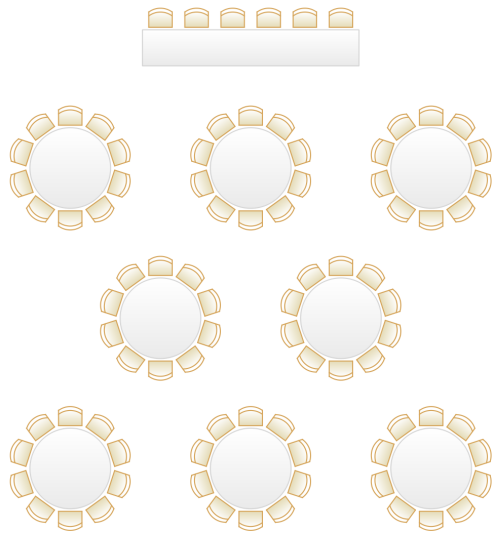
A typical wedding seating plan (created by PerfectTablePlan)
If it won't cause friction try to seat members of the bride and groom's families on tables together, it is their best chance to get to know each other.
The wedding party table should be placed where the bride and groom can see (and be seen by) as many guests as possible.
Remember that once the main wedding meal (the 'wedding breakfast') commences the bride may have taken the name of the groom. Make sure that your seating chart, place cards etc take account of this.
If you have a number of paid attendees you intend to feed, e.g. photographer, videographer etc., you may want to assign them to a separate table.
Don't forget to leave room for cake and gift tables.
Note that wedding etiquette varies between countries and cultures and you will have to tailor your wedding seating plan accordingly.
Wedding top table
The wedding party is usually seated at a long table with seats down one side. This is called the 'top table' or 'head table'.
Who to put on the top table can be a sensitive issue, especially if the parents of the bride or groom have divorced and remarried. Make sure you resolve any such issues long before the wedding day.
There are many different ways to organize a wedding top table, but traditionally:
- The groom sits to the right of the bride.
- Places alternate male-female
- Partners of the Best man and Chief bridesmaid sit at other tables.
A typical example is shown below, but you should do what feels right for you.
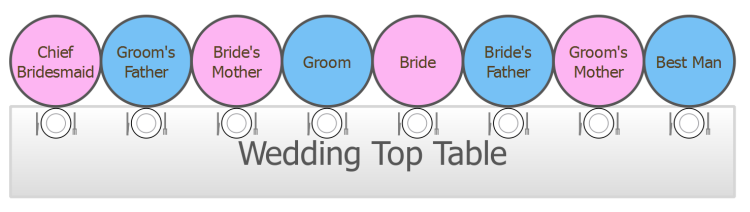
A typical wedding top table (created by PerfectTablePlan)
For a second marriage you may wish to seat children of the first marriage on the top table.
If the parents of the bride or groom have divorced and remarried it probably isn't a good idea to put them and their new partners together on the top table. One solution is to invite some family of the step-parent and put them together on a separate table near the top table.
If you are worried that someone might feel left out because they aren't on the top table, ask them to "host" one of the other tables. Make it clear who is hosting each table on the seating chart. This will help them to feel involved.
If the parents of the bride and groom are not in the wedding party they should be seated on the table nearest the top table.
It is becoming fashionable in some quarters to have the bride and groom at their own table (for example David and Victoria Beckham). This is also referred to as a "sweetheart table". This can be useful for bypassing issues about who should be on the top table.
Some couples opt not to have a top table at all, but to have two free seats at each table so they can mingle during the meal. This is a nice idea, but it does mean that two guests at each table will be seated next to empty seats for much of the reception.
Assessing your seating plan
Don't be a slave to tradition. Decide what you want for your event and create your table plan accordingly.
It is probably a good idea to show your table plan to a few key guests to ensure that it is OK and you haven't forgotten anything. Make sure you have enough time to take account of their suggestions. Don't show everyone, unless you want to make your life difficult.
Seating plan software
The traditional approach to planning seating arrangements is to write down guests' names on scraps of paper and move these around. But this is time consuming and error prone. Cutting and pasting into a spreadsheet is little better. Given that there are more ways of seating 25 guests in 25 seats than there are grains of sand in the whole world it is little wonder that creating a table plan 'by hand' is such a headache.
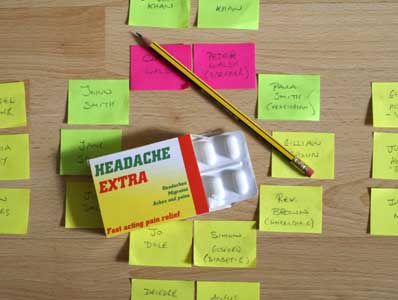
The old-fashioned approach to seating plans.
The good news is that inexpensive seating plan software is available in the form of PerfectTablePlan. PerfectTablePlan allows you to:
- automatically assign guests to the right seats with a single mouse click
- fine tune seating arrangements with drag and drop
- experiment with different table sizes, shapes and layouts
- track RSVPs and meal choices
- print plans, charts, place cards and other stationery
- handle last minute changes
And all this from only $29.95/£19.95/€26.95 + sales tax/VAT!
PerfectTablePlan is available for Windows and Mac. Why not download a free trial now?